News release – October 28, 2026

RETIME shares progress with DG HOME and 25 EU projects at the CMINE 1-2-3 webinar

On 23 October 2026, RETIME joined “CMINE 1-2-3: Project Updates Across the Clusters”, an open webinar hosted by the Crisis Management Innovation Network Europe (CMINE). It brought together projects from CMINE’s three clusters: Responder Technology (RTC), CBRN and Standardisation (CSTAC), and Societal Resilience (SRC). The webinar had 43 attendees, including Giannis Skiadaresis from the European Commission’s Directorate-General for Migration and Home Affairs (DG HOME).

The session was a response to a request from DG HOME for short, focused updates from the projects it funds. In his opening remarks, Giannis Skiadaresis said this matters because Horizon Europe is nearing its end. The Commission is preparing the next Multiannual Financial Framework and wants a clearer picture of which technologies and capabilities projects are developing with their end users. 

The format was strict. Each project had three minutes and up to three slides to present one main aim, two recent developments and three next steps. All presentations will be compiled into a booklet for DG HOME. 

RETIME’s update 

RETIME coordinator, presented the project, which is Urban Adaptation and Alert Solutions for a TIMEly (re)Action. The consortium has 18 partners and aims to give decision-makers user-friendly, effective solutions to: 

  • anticipate extreme events 
  • strengthen the safety and resilience of the built environment. 

The solutions are being designed and tested in four buildings across three pilot sites: Lisbon (Portugal), Žilina (Slovakia) and Tartu (Estonia). The hazards covered are heatwaves, earthquakes, flash and pluvial floods, droughts and cold spells. 

The two recent developments were two scientific publications: 

  • Building vulnerability: The first set out a catalogue of 121 indicators. It found that buildings’ interior features are often overlooked and that Building Information Modelling is rarely used. 
  • Community awareness: The second looked at how communities perceive environmental and climate risks. It found a significant gap between the priorities of public authorities and those of local residents. 

The next steps are: 

  • Co-design with pilot stakeholders: working with vulnerable groups, residents, building owners and building managers to set requirements for RETIME’s four solutions. These are a sensor-based automated alert system, a Digital Building Twin, a digital Building Renovation Passport, and a Resilience Knowledge Hub with a decision-support platform. 
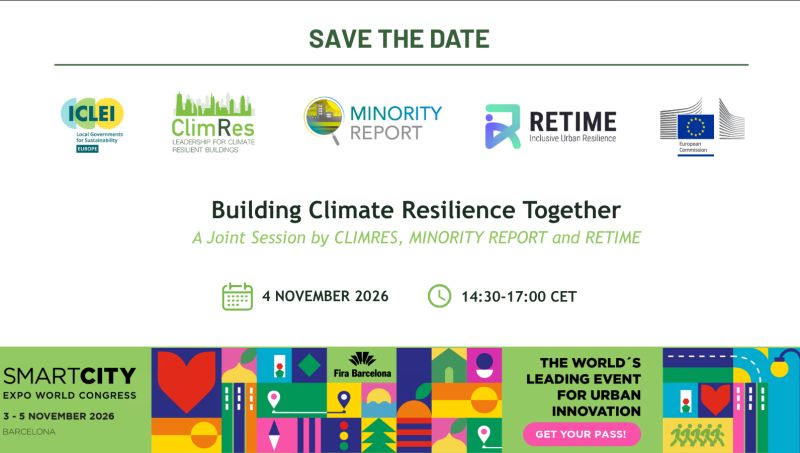
  • Smart City Expo World Congress: presenting at the congress in November, as an invited project. 
  • ICT-DM: presenting recent results at the International Conference on Information and Communication Technologies for Disaster Management. 

RETIME stated that it is open to collaborating with other projects, both now and in the future. 

A snapshot of the EU disaster resilience community 

The updates covered a wide range of work, including: 

  • personal protective equipment for first responders, procured through pre-commercial procurement 
  • AI-assisted CBRN training 
  • Copernicus-based early warning 
  • autonomous robots and drones for search and rescue 
  • systems for harmonising cross-border alerts 
  • preparing citizens through games. 

Several projects said they will be at the European Civil Protection Forum in Brussels in November. CMINE also announced plans for a fourth cluster on accelerating innovation uptake, with its first meeting planned for 10 December. 

Projects that contributed updates 

CMINE, ACTIVE PCP, PALAESTRA, UNICORN, AHEAD, SPARROW, BEHOLDER, FORESIGHT, DARE, CARMA, RETIME, RISK-CAP-RES, Civil Security Hub PL/ESA Space Resilience Nodes, AGILE, SYNERGIES, FASTER, GUARDIANS, IMPRESS, CBRNe4rail, HARMONY, ARTEMis, ECHO, B-PREPARED, RESILIACT, TOGETHER, TRIFFID. 

Watch the webinar recording: https://www.youtube.com/watch?v=4H396YtnNZU